THE MIDNIGHT SHIELD — THE THING YOU REACH FOR WHEN THE SHIFT IS FINALLY OVER
📜 THE FORGOTTEN SCROLLS: CHRONOLOGY OF THE NIGHT WATCH
THE MIDNIGHT SHIELD — THE THING YOU REACH FOR WHEN THE SHIFT IS FINALLY OVER
Because sometimes you don’t need another solution. You need a signal that you’re home.
Did you feel it tonight?
That strange change in the air when the clock passed 3:00 AM.
The ward is quiet.
Too quiet.
The fluorescent lights feel crueler than they did at midnight. A monitor flickers in the corner. Somewhere down the corridor, a trolley wheel squeaks.
You are tired enough that everything feels slightly unreal.
But you keep going.
You always do.
That’s the strange thing about night nursing.
Your body can be exhausted while your mind is still standing guard.
Still listening.
Still checking.
Still waiting for the next bell.
And then, eventually, the shift ends.
You walk out into the morning.
You drive home.
You close the door behind you.
And somehow…
you’re still at work.
🧶 THE OLD HUMAN INSTINCT: WEAR SOMETHING THAT MEANS PROTECTION
Long before scrubs, hospitals and fluorescent corridors, humans surrounded themselves with things that meant something.
Blankets.
Robes.
Amulets.
Talismans.
Symbols.
Objects carried close to the body.
Not because every object necessarily possessed supernatural power.
Because sometimes people need something physical to hold when what they’re dealing with is invisible.
Fear.
Faith.
Change.
Responsibility.
Protection.
Belonging.
The object becomes a reminder.
I am not alone.
I am protected.
I belong here.
I can get through this.
And humans have been doing this for a very long time.
🧶 THE SALISH BLANKET — MORE THAN SOMETHING WARM
Among Coast Salish peoples of the Pacific Northwest, blankets could carry meanings far beyond warmth.
Historical and cultural documentation of Salish blankets describes particular ceremonial garments in terms of protection, transformation, identity, status and important moments of life. (nebraskapress.unl.edu)
Imagine that.
A blanket isn’t just a blanket anymore.
It becomes something you wear when life is changing.
Something that tells you who you are.
Something that goes with you when you step into the unknown.
Woven protection.
Not necessarily because the fibres themselves can fight the darkness.
Because the meaning woven into them can.
🪶 THE CEREMONIAL ROBE — BECOMING SOMEONE ELSE
The Smithsonian holds a historic Chilkat blanket waist robe associated with an ixt, a spiritual specialist among the Tlingit/Tahltan peoples.
The robe was ceremonial clothing connected to a particular spiritual role. (si.edu)
And suddenly the idea feels familiar.
You put something on.
And you become someone else.
The nurse puts on scrubs.
The surgeon enters theatre.
The firefighter puts on protective gear.
The priest puts on ceremonial robes.
The clothing creates a boundary.
Before it:
you.
Inside it:
the role.
And for twelve hours, you become the person who keeps watch.
The person who answers.
The person who notices.
The person who doesn’t get to fall apart because somebody needs you.
Your scrubs aren’t magical armour.
But tell me they don’t feel like amour sometimes.
🧿 THE AMULET YOU CARRY INTO THE DARK
The Tibetan gau offers another version of the same human instinct.
A small portable amulet box, traditionally used to hold sacred objects, religious images, mantras and other meaningful materials.
The Rubin Museum documents gau as objects associated with protection and carried close to the body. (rubinmuseum.org)
Something small.
Something personal.
Something that says:
I carry this with me.
And perhaps that’s why protective objects have survived across centuries.
Because fear is invisible.
So humans make something visible.
We put meaning into an object.
Then we carry it.
🧠 AND THEN THERE ARE THE SCRUBS
Here’s where the ancient world quietly walks into the hospital.
You already have your artifact.
You just call it a uniform.
You put your scrubs on and something changes.
Maybe not chemically.
Maybe not magically.
But psychologically.
They mean something.
They mean:
Responsibility.
Competence.
Duty.
Stay awake.
Pay attention.
Someone needs you.
Research into enclothed cognition has explored whether clothing and the meaning attached to it can influence psychological processes. The original research suggested an effect, although later replication work has made the picture considerably less certain. (doi.org)
So I’m not going to tell you that your scrubs give you superpowers.
Although, frankly, some nights it feels like they should.
What matters is what they represent.
You put them on.
You enter the role.
And twelve hours later…
you need to get out of it.
🔄 THE PART NOBODY TALKS ABOUT: TAKING THE SHIFT OFF
You get home.
You shower.
You take off the scrubs.
You get into bed.
But your brain is still walking the corridor.
Still hearing the bells.
Still remembering the patient.
Still wondering whether you documented everything.
Still replaying the conversation with the doctor.
Still listening for a call that isn’t coming.
Your body is home.
Your nervous system hasn’t received the memo.
So perhaps the answer isn’t another productivity hack.
Perhaps you need a ritual.
Something simple.
Something repeated.
Something that tells your brain:
We’re done now.
Research on ritual suggests that repeated, meaningful actions can shape how we experience what comes next. It wasn’t a study of night nurses, and it certainly didn’t prove that a shower and blanket switch off the nervous system.
Still…
you know what a ritual feels like.
The same shower.
The same quiet room.
The same cup.
The same blanket.
The same sequence.
Again.
And again.
Until your body begins to recognize it.
🛡️ THE MODERN PROTECTIVE ARTIFACT
So imagine this.
The hospital is behind you.
The scrubs are in the laundry.
The shower is finished.
The curtains are closed.
The room is dark.
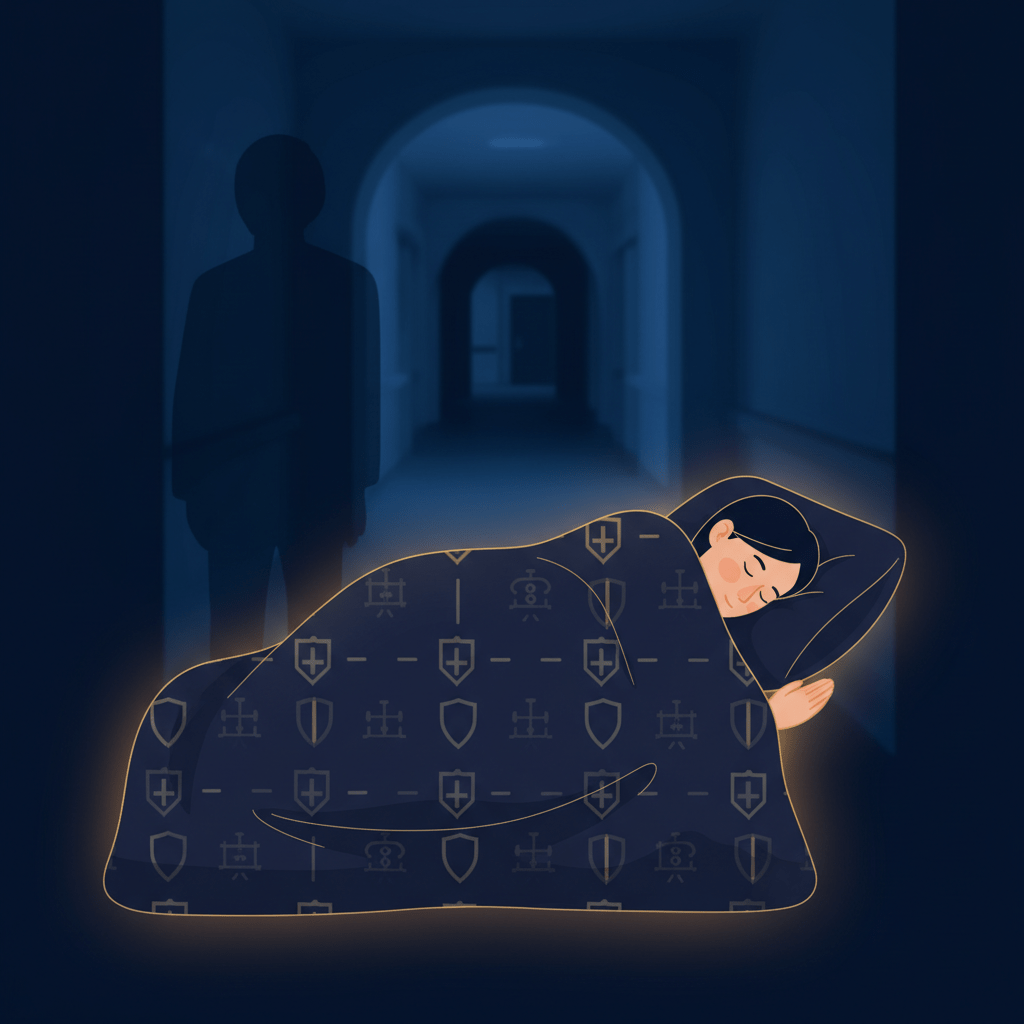
You climb into bed.
And you reach for something that belongs to you.
Not the hospital.
Not management.
Not the patients.
Not the staffing crisis.
Not the next shift.
You.
Something heavy.
Soft.
Familiar.
Something you use only when the armour comes off.
It doesn’t need to cure anything.
It doesn’t need to have mystical powers.
It doesn’t need to promise better sleep.
It simply needs to mean:
I’m home.
The shift is over.
Nobody needs me right now.
I can put the armour down.
And perhaps that is enough.
🌑 WHAT IF THE MAGIC WAS NEVER IN THE OBJECT?
Maybe that’s the real mystery.
The blanket.
The robe.
The amulet.
The uniform.
The object itself may be only half the story.
The other half is meaning.
Humans have always done this.
We take something ordinary.
We give it a story.
And eventually…
the object carries the story for us.
So perhaps the question isn’t:
“Does it really protect me?”
Maybe the better question is:
“What does it remind me of?”
Because after twelve hours in the dark, sometimes you don’t need another piece of equipment.
You need a boundary.
A signal.
A ritual.
A moment where someone — even if that someone is you — finally says:
You’ve done enough.
🦉 SHIFT CLOSED
The Salish had their woven garments.
Tibetan practitioners carried their amulets.
Spiritual specialists wore ceremonial robes.
Nurses have scrubs.
And maybe the modern night-shift worker needs something else too.
Something that represents the opposite of clinical duty.
Not vigilance.
Not responsibility.
Not another task.
Release.
That is the idea behind the Vampire Shift Protective Blanket at The Owl Nurse.
Not a miracle.
Not medical equipment.
Not a magical cure.
A comfort artifact.
A physical part of the ritual. Something that says…
The hospital stays outside.
The armour comes off.
The night is finished.
You belong to yourself again.
Because after twelve hours of carrying everyone else…
you are allowed to put the weight down.
The ward is closed.
The gates are locked.
The night has taken enough.
SHIFT CLOSED.
Maybe the ancient world wasn’t so different from us…
📚 SOURCES & FURTHER READING
Tepper, Leslie H., Janice George & Willard Joseph.
Salish Blankets: Robes of Protection and Transformation, Symbols of Wealth. University of Nebraska Press.
Smithsonian Institution — National Museum of Natural History.
Dance Apron / Chilkat Blanket Waist Robe. (si.edu)
Rubin Museum of Himalayan Art — Project Himalayan Art.
Amulet Box (Gau) with Its Contents. (rubinmuseum.org)
Adam, H. & Galinsky, A. D. (2012).
Enclothed Cognition. Journal of Experimental Social Psychology.
Burns, D. M. et al. (2019).
An Old Task in New Clothes: A Preregistered Direct Replication Attempt of Enclothed Cognition Effects on Stroop Performance.
Vohs, K. D., Wang, Y., Gino, F. & Norton, M. I. (2013).
Rituals Enhance Consumption. Psychological Science.
🌒 A NOTE FROM THE FORGOTTEN SCROLLS
Maybe the ancient world wasn’t so different from us.
They had their amulets.
We have our uniforms.
They had their rituals.
We have the shower after the night shift.
They had objects that told them:
You are protected.
We have objects that can tell us something perhaps even more important:
You are allowed to stop.
Note: The Facebook Group is our temporary launch incubator. Our fully private custom platform is under construction right here on the website!